
Every Australian uni student eventually has the same realisation: nobody ever explicitly taught you how to read a rubric. You were handed one in week one of your first semester, told to “read it carefully,” and then marked against a document you weren’t sure how to interpret. You submitted assignments feeling confident, got marks that didn’t match, and stared at feedback that read like another language. “Needs more depth.” “Engage with the literature.” “Strengthen your argument.” What does any of that mean?
I spent years hitting this exact wall. I’m Rodney, MBA graduate with Executive Dean’s Commendation, now studying postgraduate IT (Computer Science) and pulling Distinctions and High Distinctions consistently. But it took me a decade of study across multiple degrees (and several dropouts: Business Bachelor’s, OH&S Diploma, LEAN Diploma, Master of Marketing) before I figured out that the rubric wasn’t just a marking grid. It was the answer key hiding in plain sight. And decoding the language your lecturers use isn’t something that happens naturally. It’s a learnable skill that the system assumes you already have.
This is the pillar guide for understanding assignments and rubrics in the Australian university system. If you want to know how rubrics are actually constructed, how to reverse-engineer them into HD-level work, how to decode cryptic feedback, how to write real critical analysis, and how to retain enough across a semester that your assignments build on something rather than starting from zero. It’s all here, with links to the full cluster articles for each subtopic.
Quick Version (3-Minute Read)
If you only read one part before your next assignment, use this:
- Start with your target grade column (Credit, Distinction, or HD), not the full grid.
- Translate each rubric criterion into concrete checklist actions before you begin writing.
- Prioritise your time by weightings (for example, 40% analysis beats 5% formatting every time).
- Keep the rubric open while drafting and check each paragraph against one criterion.
- Before submitting, run a self-check against every criterion and mark where you sit.
If you want the full playbook, keep reading. If you’re in a rush, jump straight to:
- How To Read A Rubric Properly
- Planning Assignments Backwards From the HD Column
- Writing Critical Analysis
What Australian Rubrics Actually Are (And Why They Exist)
A rubric is a marking guide that breaks down exactly what your lecturer is assessing. Most follow the same structure: criteria (what you’re being assessed on) down the left, performance levels (Fail, Pass, Credit, Distinction, High Distinction) across the top. Each cell describes what that criterion looks like at that grade level.
The Policy Framework Behind Your Rubric
Rubrics aren’t optional. Every Australian university is required to have clear, criteria-based assessment under sector-wide quality standards. TEQSA’s guide to designing assessment rubrics is the sector reference document, your lecturers are working from something very close to it when they write your rubric. Western Sydney University’s Criteria and Standards-Based Assessment policy is a good public example of what the institutional layer looks like, and the University of Wollongong’s student-facing rubric guide is one of the clearer plain-language explanations of how to read one.
Analytic vs Holistic Rubrics
Two main types. Analytic rubrics break an assignment into separate criteria, Research Quality, Critical Analysis, Written Communication, Referencing, each scored independently. Holistic rubrics give one overall score for the whole piece. Analytic rubrics are your friend: they tell you exactly where the marks are and where to put your effort. If Research Quality is worth 40% and Referencing is worth 5%, you know exactly where your time should go.
Why Rubrics Feel Vague
Because the language is deliberately high-level. “Sophisticated understanding.” “Critical engagement with literature.” “Clear and logical presentation.” These phrases feel slippery because they’re meant to apply across subjects, topics and assignment types. The skill isn’t reading the words. It’s translating them into concrete actions for your assignment. That translation process is what this guide is about, and it’s covered in depth in How to Read a University Rubric (And Actually Use It to Get Better Grades).
How To Read A Rubric Properly
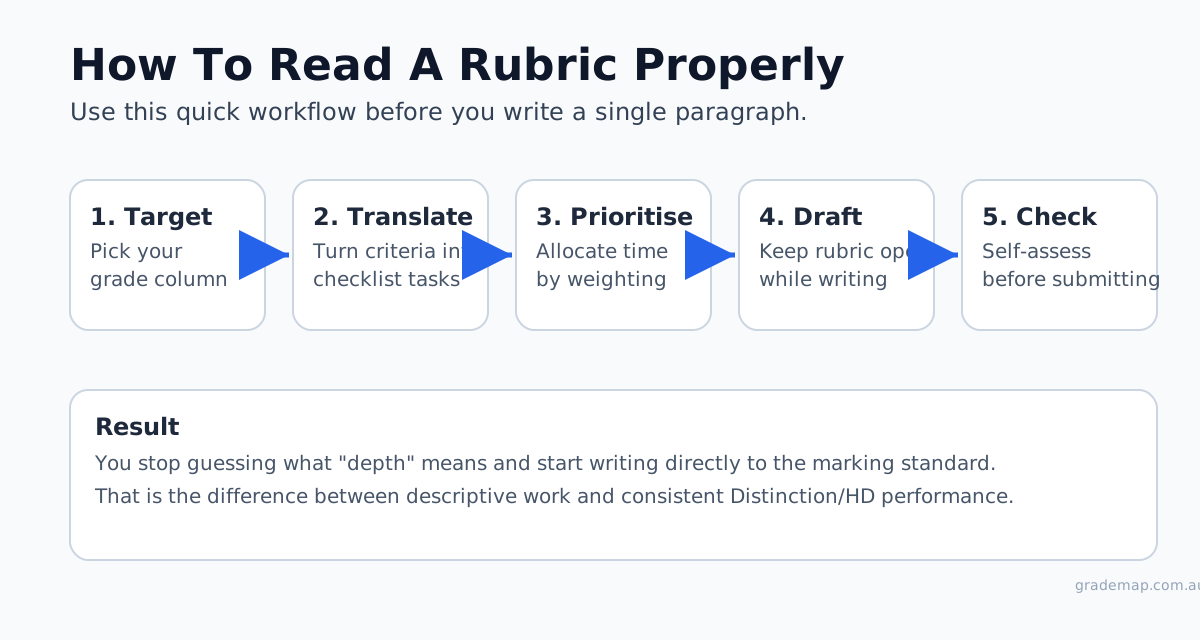
Diagram: the five-step rubric-reading workflow you can run before every assignment.
Here’s the reading sequence I use before I touch any assignment.
Start With the Column You’re Targeting
If you’re aiming for a Distinction, read only the Distinction column first. Not the HD, not the Credit, just the column that represents what you’re trying to produce. This stops you from getting overwhelmed by trying to hit every level at once, and it forces you to form a clear mental picture of the target.
Translate Each Criterion Into a Checklist
Take each criterion in your target column and turn it into concrete tasks. “Uses current, credible sources to support arguments with sophisticated integration of evidence” becomes: find sources published within the last 5 years, use peer-reviewed journals and reputable publications, make sure sources directly support your main arguments, weave citations into your writing rather than dumping them at the end of paragraphs. Do this for every criterion before you write a word.
Identify the Weighted Criteria
Check the rubric weights. If “Critical Analysis” is 40% and “Referencing” is 5%, your time should reflect that ratio. Most students unknowingly distribute their effort evenly and wonder why their grades plateau. Weighted prioritisation is the single biggest grade lever most students ignore.
Use the Rubric As A Progress Tracker
Keep the rubric open while you work. Every hour or so, pause and check: am I tracking against the target criteria right now? If no, adjust. This turns the rubric from a marking document into a live quality-assurance tool.
For the full reading framework with worked examples, including how to handle vague rubric language, rubric traps to avoid and how to read between the lines of criteria descriptors, see How to Read a University Rubric.
Planning Assignments Backwards From the HD Column
Reading a rubric is step one. Planning your assignment from the rubric is where grades actually change. The default student approach is: read the brief, start researching, start writing, check the rubric at the end. This is backwards. The rubric isn’t a post-hoc checker. It’s a specification. HD students plan from the rubric, not to the rubric.
This approach is essentially backward design, a concept widely used in curriculum design itself. The University of Iowa’s explanation of backward design and Ohio State’s backward design guide both frame it as starting from the desired outcome and planning back to the first step. The same logic applies to assignments. Start from “HD at this criterion looks like X,” and work back to the research, reading and writing you need to get there.
My Actual Essay Writing Sequence
My actual approach to a research essay isn’t a time-allocation percentage. It’s a sequence. The thing that changed my grades was working out that you don’t start at the start. You start with your hypothesis or position. What are you actually arguing? What’s the claim you’re going to defend? Once that’s clear, you go looking for research that covers your hypothesis specifically, not generic “relevant literature”. You build your reference list as you go, not at the end.
From there, I sketch the section structure and allocate word count to each section, sometimes the ELA or your tutor will tell you what the section split should be, which saves you the guesswork. I aim for roughly one reference per 150 words as a research-density target, which translates to about 20 sources for a 3,000-word essay. Anything much thinner than that and I’m not building an argument; I’m just asserting one.
Then comes the counterintuitive part. I leave the introduction and conclusion until last. Build the middle first, the argument, the evidence, the synthesis. Work out whether your hypothesis actually holds after all that research (sometimes it doesn’t, and that’s the real moment of learning). Once the body is solid, write the conclusion. That’s easy now because you know what you actually concluded. Then write the introduction, because only now do you know what the essay is actually about and what you’re genuinely setting up.
It’s OK if your hypothesis turns out to be wrong. An assignment where your research genuinely contradicts your starting position can score higher than one where you “win” comfortably, if you show the work. Compare and contrast the evidence on both sides, acknowledge where the data changed your mind, and let the essay demonstrate the intellectual honesty that HD descriptors explicitly reward. A revised, evidence-backed position is a stronger outcome than an unchanged one you clung to past the point of being defensible.
Most students do this in reverse: intro first, then struggle through the body because they’ve already committed to a thesis that doesn’t quite match the evidence they eventually find. Working back to front fixes that.
For the full backwards-planning framework with worked examples, see How to Plan Your Assignment Backwards from the Rubric.
Decoding Assignment Feedback
Getting feedback on your assignment and not knowing what it means is the most demoralising part of university. Here’s how to decode the most common phrases.
The Hidden Language of Academic Feedback
“Needs more depth” means you described what happened but didn’t analyse why it matters. Add “so what? why does this matter? what are the implications?” to every paragraph. “Engage with the literature” means cite more sources and actually discuss them, not just drop a citation and move on. “Strengthen your argument” usually means your thesis is unclear, your evidence doesn’t support your position, or you haven’t addressed counterarguments. “Improve structure” means your ideas don’t flow logically; read just your topic sentences and see whether they tell a story. “Consider alternative perspectives” means you’ve presented one side.
The University of Wollongong’s guide on understanding assessment feedback is one of the clearest plain-language walkthroughs of the feedback vocabulary. Deakin’s student blog gives a practical translation-table approach. ANU’s guidance on dealing with feedback treats feedback as professional development rather than one-off correction.
Map Every Comment Back To A Rubric Criterion
This is the single highest-leverage trick I know. When you get feedback, map each comment to the rubric criterion it relates to. “Needs more depth” mapped against the “Analysis” criterion tells you you were probably scoring at Pass or Credit level when the HD descriptor called for “sophisticated analysis of complex issues.” Now you know exactly what “depth” means in your subject’s context.
Feed-Forward Beats Feedback
When feedback comes back, I map each comment to the rubric criterion it relates to, and I carry those themes forward into the next assignment. I do this in GradeMap, one of the main reasons I built it. When I start a new subject I load in the course’s learning outcomes, so everything ties together: the outcomes feed into the rubric, the rubric feeds into my assignment plan, and the feedback from one assignment feeds into the next. By the end of the semester GradeMap is holding a picture of what the course was actually trying to teach me, where I’ve demonstrated it, and where I’m still short.
You can do something similar without GradeMap, a notes doc, a spreadsheet, a physical notebook, whatever, but the move that matters is treating feedback as the specification for the next piece of work, not just a post-mortem on the last one.
For the full decoding dictionary, the feedback translation table, and how to handle contradictory feedback, read How to Decode Your University Assignment Feedback.
Writing Critical Analysis (The Single Most Requested Skill)
If “needs more critical analysis” is the most common feedback phrase in Australian universities, and in my experience, it is, then learning to write critical analysis is the single most valuable skill you can build.
What Critical Analysis Actually Is
It’s evaluation, not criticism. It’s not about finding fault or being negative. It’s about asking “so what? why does this matter? what are the implications?” instead of just describing what happened. The University of Wollongong’s critical analysis guide frames it as examining information to understand how it’s constructed and what it means. UTS HELPS’s guide on writing critically goes further, explaining that critical writing evaluates the strength of evidence and compares different perspectives.
Descriptive writing tells you what happened. Analytical writing tells you what it means and why. That distinction is the line between a Pass essay and a Distinction essay in almost every writing-heavy subject I’ve taken.
The Writing Style Your Subject Actually Wants
Here’s something that took me longer than it should have to figure out. Each subject has its own preferred style of writing, and universities usually publish that style in their own writing guides, you just have to go looking. The University of Wollongong’s critical analysis guide, UTS HELPS’s guide on writing critically, Monash’s Student Academic Success resources, these aren’t afterthought links in the syllabus. They’re the actual playbook your assignment is being marked against. Read them before you write, not after.
The second thing that moved me forward was attending ELA (Educational Learning Advisor) sessions whenever they were offered. A decent ELA will often run a session specifically on the writing style required for the type of assignment in front of you. In one HR subject I took during my MBA, a subject I did not enjoy, but that’s a separate story, the ELA ran a session on the “Hamburger” essay-writing method and literally required us to write in that style.
The Hamburger method is a paragraph-structure approach that sounds simple until you try to do it properly, and then you realise it’s one of the harder things in academic writing to execute consistently. Each paragraph has three layers, like a burger:
- Top bun: a topic sentence that clearly states what the paragraph is about
- The filling: the supporting evidence, examples, citations, and analysis, the actual content
- Bottom bun: a concluding or linking sentence that closes the thought and bridges to the next paragraph
Proper Hamburger execution is much harder than it looks. That’s partly why a good ELA will dedicate an entire session to teaching it. Most students lose marks here for one of two reasons: either their paragraph body drifts off the promise the topic sentence made (you promised an argument about X, then wrote about Y), or they skip the bottom bun entirely and the essay reads as a disconnected list of facts with no progression. The discipline is in making every paragraph do both things, stand on its own feet AND connect forward to the next one. That’s the move most students skip, and it’s often the difference between a Pass essay and a Distinction.
Between the university’s own writing guides and the ELA sessions, you can build yourself a subject-specific style handbook in the first two weeks of every new subject. That’s far more useful than any generic critical-analysis framework, because it’s what your actual markers will actually mark you against.
Finding Sources And Evaluating Them
Critical analysis depends on having good sources to compare. The University of Newcastle’s critical analytical essay process PDF and James Cook University’s sample critical essay are both useful concrete examples of what the finished product should look like. ANU’s guide to evaluating sources covers the evaluation step well.
Common Mistakes
Only describing sources without evaluating them. Presenting only one perspective. Using “I think” without evidence. Avoiding taking a position because it feels safer to sit on the fence. None of these are critical analysis. They’re descriptive writing with extra words.
For more on the vocabulary of critical analysis and how to apply it across literature reviews, case studies, research reports and argumentative essays, read How to Write Critical Analysis for University Assignments.
Active Recall With a Twist: How I Actually Retain Things Across a Semester
Here’s the part most rubric and assignment guides skip: your assignments don’t happen in a vacuum. They build on concepts from your lectures and readings. If you can’t retain what you learned in week 3 by the time you’re writing the week 8 assignment that depends on it, you’re re-learning instead of building.
I have to be honest about something. I don’t use Anki. I don’t have a structured spaced-repetition system. I’ve tried them and they didn’t stick for me, which is a perfectly normal outcome for most people, and if you’ve had the same experience you’re in good company. What I did work out, though, is a version of active recall that fits my actual study rhythm and uses tools I’m already using.
Here’s what I do. At the end of most study weeks, I have an AI quiz me on the concepts from that week’s readings and lectures. Not generic textbook-surface quizzing, specific questions drawn from the actual material I’ve been through, the kind a strict marker would ask. I was using Claude directly for this, pasting in my notes and readings and asking for quiz questions. Now I use GradeMap for the same job, which I built partly to make this exact workflow less tedious, it already knows what subject I’m in and what I’ve been studying, so I don’t have to re-establish the context every time I open a new chat.
When the AI asks me something and I get it wrong, it doesn’t just correct me and move on. It goes deeper on that specific weak spot, explains the concept from another angle, gives me a worked example, then quizzes me again on the same idea until I’ve actually understood it, not just memorised a surface-level answer.
That’s my version of repetitive learning. It combines two things the cognitive science says genuinely work: active recall (testing yourself instead of re-reading) and adaptive depth (spending more time on the things you’re weakest at, not treating every concept equally). Birmingham City University’s guide on active recall and the University of Arizona’s Thrive Center both explain why active recall beats passive re-reading, and Pittsburgh’s study lab walkthrough has a clear explanation of the traditional formal spaced-repetition approach if you want to try it by the book. BCU’s 2357 method guide is the cleanest introduction to the schedule.
If you can stick to Anki or the 2357 method, great, the evidence is that it works. But if you’ve tried and bounced off (and most people do, because the adherence problem is real), then AI-driven active recall is a genuinely effective alternative that uses a tool you’re probably already using for other things. The move that matters is that you’re retrieving, not re-reading. Whatever tool makes retrieval stick for you is the right tool.
For the full treatment including how to make retention work across a fragmented semester, read Spaced Repetition for Uni Students: Study Less, Remember More.
The Assessment Reform Context
One more thing you need to understand about Australian assignments in 2026: the assessment landscape is changing, and it’s changing because of AI.
TEQSA’s assessment reform agenda and its 2025 paper Enacting assessment reform in a time of artificial intelligence are pushing universities toward authentic assessment, oral exams, process portfolios, in-class components, reflective journals, tasks that ask you to apply concepts to your own experience. Individual case studies published through TEQSA, like Adelaide University’s Don’t be sorry, just declare it work, show what this looks like in practice.
What this means for you: your rubrics are going to keep evolving. They’ll emphasise thinking you can demonstrate, not just output you can produce. Critical analysis and personal synthesis will matter more, not less. The rubric-reading, backward planning, feedback decoding and analysis-writing skills this guide covers are exactly the ones that will travel with you into whatever the new assessment landscape looks like.
Putting It All Together: Your Assignment Playbook
Here’s the end-to-end workflow that comes out of everything above. It’s the process I’ve converged on after a lot of trial and error, and every step is something I actually do.
Step 1: Read the rubric before the brief. Go straight to the HD column and read only that column first. Translate each criterion into a checklist of concrete tasks. Note the weights. This is your specification, everything else in the assignment is negotiable.
Step 2: Hunt the rest of the rubric for mark-losers. Do a second pass through the lower grade bands, the Pass, Credit, and “unsatisfactory” descriptors, and look specifically for the things that will cost you marks. Repeated citation errors, missed criteria, unsupported claims, failure to engage with alternative views, whatever your specific rubric flags. Write these down as a “don’t do” list and keep it visible while you draft. Before you submit, check the list one more time and make sure you haven’t quietly drifted into any of them. This single habit has saved me more marks than any other rubric technique I’ve tried. It’s easier to hit HD by not losing marks than by doing more impressive work.
Step 3: Decode what the assessment is really asking for. Paste the brief and the rubric into Claude or GradeMap and ask: “What would an HD response demonstrate that a Credit response wouldn’t?” Not to write the assignment for you, to make sure you understand what the markers are actually going to reward before you start.
Step 4: Start from your hypothesis, not the research. What are you arguing? What’s the claim you’re going to defend? Write that down first, then go looking for research that covers it specifically. Aim for around one reference per 150 words as a density target. And here’s the thing most students miss: it’s OK if your hypothesis turns out to be wrong. An assignment where your research genuinely contradicts your starting position can score higher than one where you “win” comfortably, if you show the work. Compare and contrast the evidence on both sides, acknowledge where the data changed your mind, and let the essay demonstrate the intellectual honesty that HD descriptors explicitly reward.
Step 5: Plan the sections and sketch the middle first. Break the word count across sections. Sometimes your ELA or tutor will tell you the split, if they do, use their numbers. If they don’t, let the rubric weightings be your guide: if Critical Analysis is worth 40% and Referencing is 10%, that’s a rough indicator of where your word count and your effort should go.
Run the numbers. For a 3,000-word essay with a rubric weighted 40% Critical Analysis / 30% Research / 20% Structure / 10% Referencing, the analysis and research weights map cleanly to word allocations, roughly 1,200 words doing critical-analysis work and 900 engaging with evidence. Structure and referencing are different. They’re quality criteria that apply across the whole essay, not sections with their own word budgets. Reference lists generally sit outside your word count (though in-text citations don’t), and the 10% “referencing” weight really just means you need to get citation style, density, and accuracy right across everything else you’ve written. The percentages are telling you where to invest your effort, not how to carve up the page.
Then draft the middle of the essay first: the argument, the evidence, the compare-and-contrast synthesis. This is where the heavy lifting happens.
Step 6: Write in the style your subject actually wants. Use your university’s writing guides, they publish them for a reason. Attend ELA sessions when they’re offered; they’ll often teach the specific style your subject expects (the Hamburger method for most writing-heavy subjects, IMRaD for research reports, argument-counterargument for debate essays). Build yourself a subject-specific style handbook in the first two weeks of every new subject.
Step 7: Write the conclusion, then the introduction, in that order. Only now, once you know what you actually concluded, is it easy to write a good conclusion. And only now can you write an introduction that genuinely sets up the essay instead of committing you to a thesis your evidence didn’t actually support.
Step 8: Close the loop on feedback and retention. When feedback comes back, map every comment to the rubric criterion it relates to, and carry those themes forward into the next assignment. I do this in GradeMap, but a notes doc works too, the move that matters is that feedback becomes the specification for your next piece of work, not a post-mortem on the last one. And at the end of each study week, have an AI quiz you on what you covered and go deeper on whatever you got wrong. (I was using Claude for this; now I use GradeMap.) That’s how content actually sticks across a semester instead of evaporating as soon as you submit.
That’s the whole playbook. It’s not mysterious. It’s not a gift some students have and others don’t. It’s a learnable, repeatable sequence I’ve built up over twenty years of study attempts, and the parts that work, work because they’re grounded in what real markers actually reward and what real retention actually looks like.
References
Australian National University. (n.d.). Dealing with feedback. Academic Skills.
Australian National University. (n.d.). Evaluating sources. Academic Skills.
Birmingham City University. (n.d.). Active recall.
Birmingham City University. (n.d.). Spaced repetition and the 2357 method.
Deakin University. (2023). Received a disappointing grade? Learn how to interpret and translate feedback.
James Cook University. (n.d.). Sample student critical essay. Learning Centre.
Ohio State University. (n.d.). Using backward design to plan your course.
TEQSA. (2022). Designing an assessment rubric.
TEQSA. (2024). Gen AI, academic integrity and assessment reform.
TEQSA. (2025). Enacting assessment reform in a time of artificial intelligence.
TEQSA. (n.d.). Don’t be sorry, just declare it, Adelaide University case study.
University of Arizona. (n.d.). Adding Spaced Repetition to Your Study Toolkit.
University of Iowa. (n.d.). Designing intentional courses through backward design.
University of Newcastle. (n.d.). Critical analytical essay process.
University of Pittsburgh. (n.d.). Spaced repetition, study skills tools & resources.
University of Technology Sydney. (n.d.). How to write critically.
University of Wollongong. (n.d.). Critical analysis.
University of Wollongong. (n.d.). Understanding assessment feedback.
University of Wollongong. (n.d.). Understanding marking rubrics.
Western Sydney University. (2024). Criteria and Standards-Based Assessment policy.
FAQ
What if my rubric has really vague language?
Translate each criterion into a concrete checklist before you start writing. If “critical analysis” is vague, compare it across grade levels, the difference between the Pass descriptor and the HD descriptor shows you what “critical” actually means in that context. If it’s still unclear, email your lecturer with a specific question: “For the critical analysis criterion, would comparing the strengths and limitations of Smith’s theory versus Jones’ approach meet the HD standard?” Specific questions get specific answers.
Should I aim for HD criteria even if I’m happy with a Credit?
Focus on consistently hitting your target grade first. If you’re aiming for Credit, master the Credit column across all criteria before attempting HD work on a single criterion. Confidence at one level beats inconsistency across levels.
How much time should I spend reading the rubric vs writing?
Read the rubric before you start. Re-read it at the end of your research phase. Keep it open during drafting. Read it once more before submission as a self-assessment pass. It’s the single highest-leverage document in your assignment, and most students spend less time on it than they spend on the cover page.
What does “critical analysis” actually mean across different subjects?
The core principle is the same, evaluate, don’t just describe. But the form varies: in literature reviews, it’s comparing themes and gaps across sources; in case studies, it’s evaluating decisions against alternatives; in research reports, it’s discussing implications and limitations; in argumentative essays, it’s acknowledging counterarguments and explaining why your position is stronger. The four moves work across all of them.
How do I handle feedback that seems to contradict the rubric?
Ask for clarification. Politely and specifically. “Thanks for the feedback. I scored at Credit level for ‘use of evidence’, but the comments don’t mention sources or data. Could you point me to what was weak in that area so I can improve for the next assignment?” Lecturers are usually happy to clarify when you’ve clearly put effort in first.
Is it worth arguing a grade?
Rarely. Usually the better investment is understanding the feedback and applying it to the next assignment. The exception is if feedback genuinely contradicts the rubric or there’s an obvious error, in that case, request a formal review through your unit’s grade review process. Most universities have one.
How do spaced repetition and rubric-focused work fit together?
Spaced repetition builds the deep foundation (concepts, definitions, frameworks). Rubric-focused work builds the output (assignment-ready critical analysis, structured arguments, evidence integration). You need both. The concepts are what you draw on during your assignment; the rubric is the target you’re hitting with them. Students who do one without the other either know the content but can’t perform on assessment, or perform on assessment without really understanding the content. Both will hit a ceiling eventually.